The electric kettle — a modern staple in homes, cafés, and offices — transformed the simple act of boiling water into a fast, efficient, and automatic process. But who actually invented it? The answer spans more than a century of design evolution, from early mechanical prototypes to today’s precision-controlled kettles such as those from Hughes Coffee.
The world’s first electric kettle was invented in 1891 by the Carpenter Electric Company in the United States.
The heating element was placed in a separate water chamber — outside the main body of the kettle.
As a result, it took nearly 12 minutes to bring water to a boil.
Despite its inefficiency, it marked the birth of electric water heating, paving the way for safer and more compact designs.
At the time, electricity was just becoming common in households, so this invention represented cutting-edge technology for the late 19th century.
While the Carpenter Electric model was the first, the modern electric kettle as we know it was invented in 1922 by Arthur Leslie Large, working for Swan Company in the UK.
Large introduced a sealed heating element placed directly inside the water.
This innovation dramatically shortened boiling time.
It also improved energy efficiency and made the appliance more compact.
This design became the foundation for all future electric kettles.
In 1955, Russell Hobbs, a British company founded by Bill Russell and Peter Hobbs, introduced the K1 model, the first electric kettle with an automatic shut-off mechanism.
A built-in bi-metallic thermostat detected steam and turned off the kettle once boiling was reached.
It eliminated the risk of boil-dry accidents and overheating.
The K1 was compact, reliable, and instantly popular — setting the standard for modern electric kettle safety design.
This was arguably the biggest single leap in kettle innovation — combining efficiency, automation, and user safety.
By the late 20th century, electric kettles had become household essentials.
Manufacturers began focusing on temperature control, aesthetic design, and energy efficiency.
Variable temperature controls for coffee and tea brewing.
Cordless designs with 360° rotating bases.
Double-wall insulation to retain heat.
Stainless steel and glass models for hygiene and visual appeal.
These modern improvements allow consumers to heat water faster, safer, and with greater control — perfect for precise brewing, especially in the specialty coffee industry.
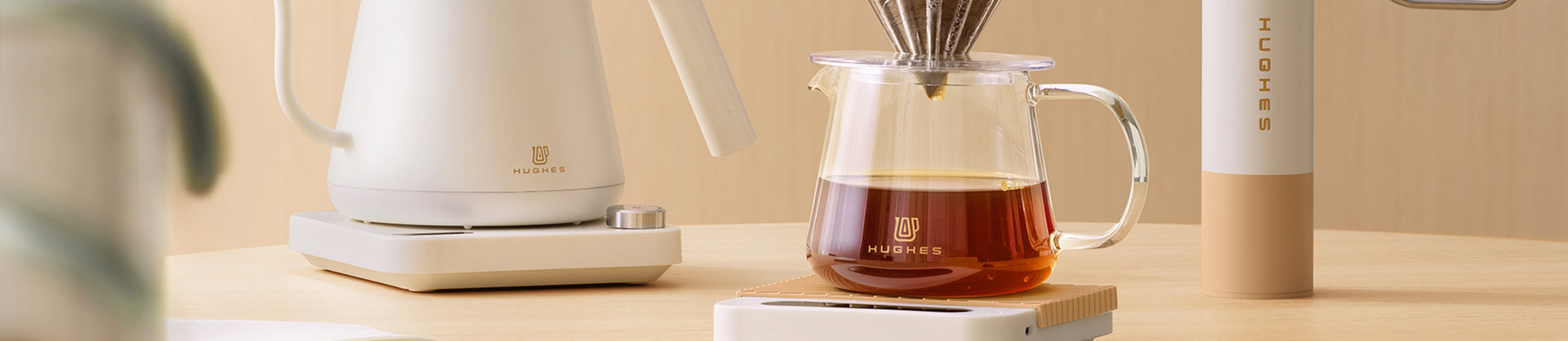
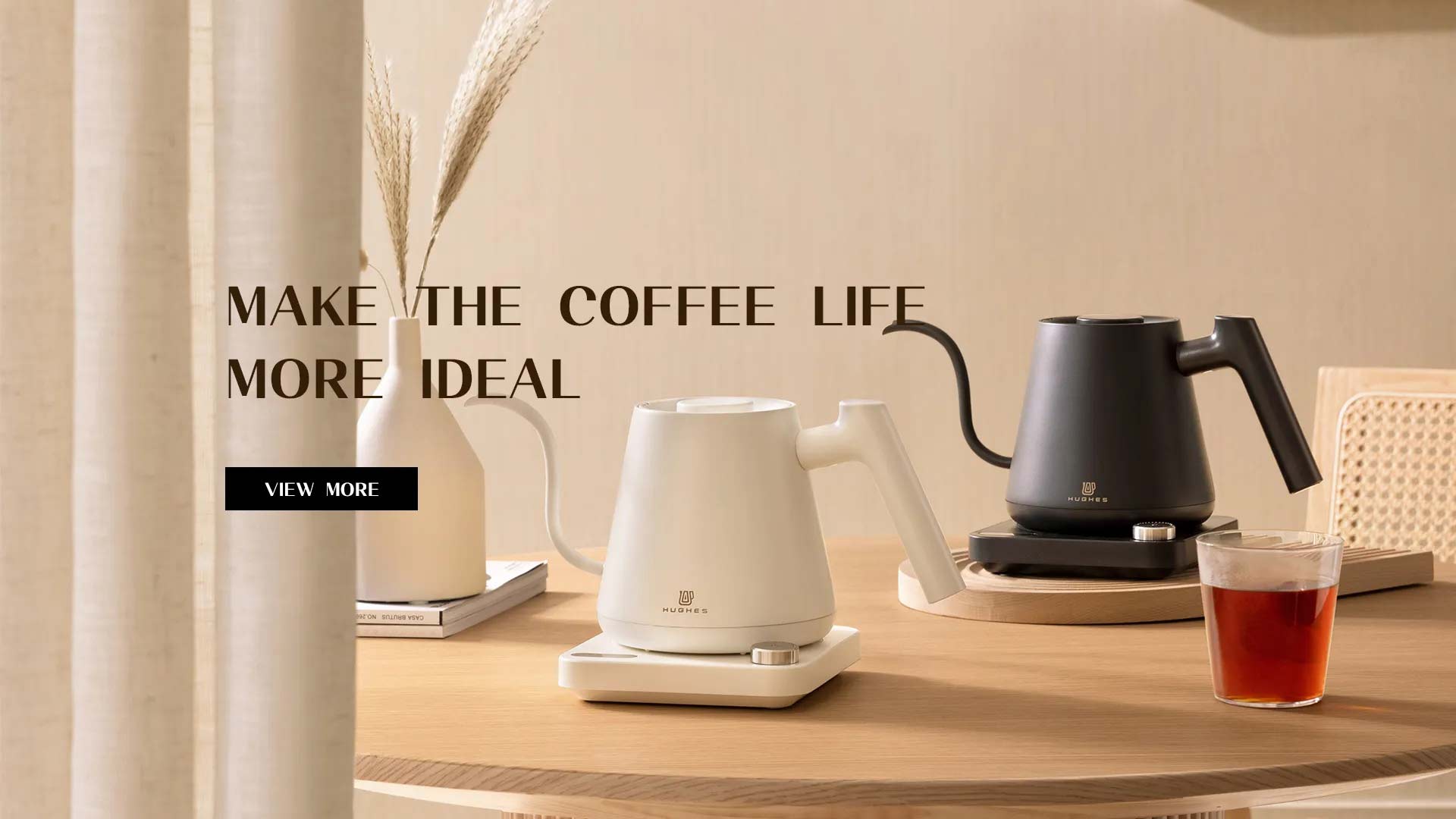
Hughes Coffee continues this legacy of innovation through its line of electric pour-over kettles and precision temperature models, designed for today’s coffee and tea professionals.
Fast heating elements for rapid boiling.
Automatic shut-off and boil-dry protection for safety.
Ergonomic gooseneck spout for controlled pouring.
Adjustable temperature settings for perfect brewing precision.
CE- and ISO9001-certified quality ensuring durability and safety.
Hughes combines over a century of design evolution with modern brewing intelligence, making its kettles ideal for home baristas and café environments alike.
| Year | Innovator / Company | Key Milestone |
|---|---|---|
| 1891 | Carpenter Electric Company (USA) | First electric kettle invented |
| 1922 | Arthur Leslie Large, Swan Company (UK) | Introduced internal heating element |
| 1955 | Bill Russell & Peter Hobbs, Russell Hobbs (UK) | First automatic shut-off kettle (K1) |
| 2000s–Present | Global manufacturers | Smart temperature control, safety, and design innovations |
From Carpenter Electric’s early prototype to Hughes Coffee’s advanced models, the electric kettle has evolved from a novelty into a precision appliance essential for modern living.
The electric kettle wasn’t the work of one inventor but a series of engineering advancements over more than a century. Starting with Carpenter Electric’s 1891 model, perfected by Arthur Leslie Large in 1922, and revolutionized by Russell Hobbs in 1955, each milestone contributed to the safe, efficient, and intelligent kettles we enjoy today.
Hughes Coffee continues this tradition of innovation with state-of-the-art electric kettles engineered for speed, precision, and elegance — proving that even in the age of smart devices, a perfectly brewed cup still begins with a perfect kettle.

 WhatsApp:
 Mobile Phone:
 Contact Now