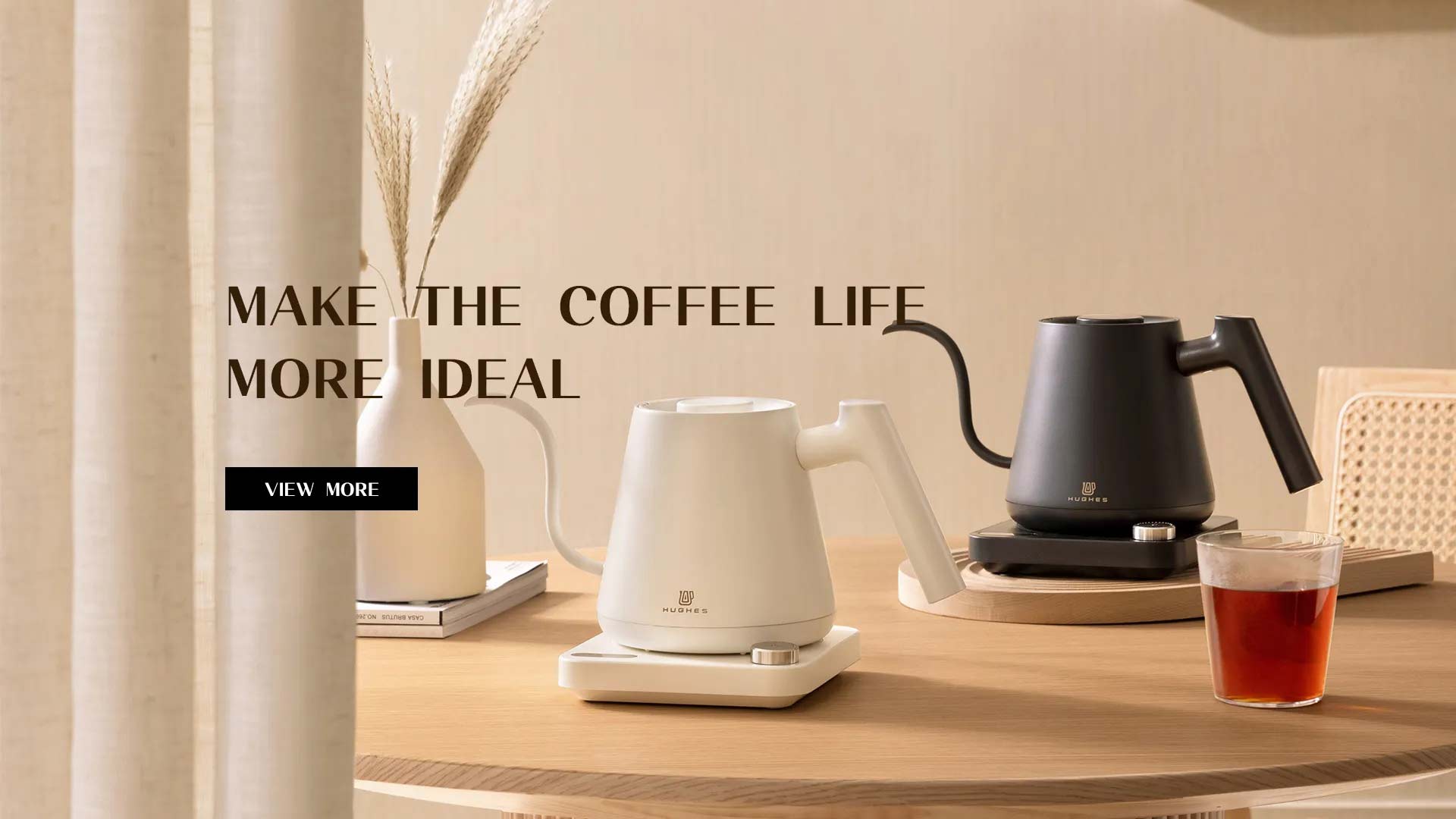
Temperature control on an electric kettle is not a luxury feature. It is a functional upgrade that directly affects beverage quality, product positioning, and long-term usability. In modern coffee and tea preparation, water temperature is one of the key variables that determines taste, consistency, and repeatability. HUGHES explains that temperature-control kettles allow users to heat water to a precise level and maintain it, which improves both brewing results and daily convenience.
Different drinks require different water temperatures. Boiling water is not always the best choice. For tea, lower temperatures help preserve delicate flavors and reduce bitterness. HUGHES notes that temperature control helps prevent over-extraction in tea, which directly improves taste balance. For coffee, especially pour-over brewing, water that is too hot can lead to excessive bitterness, while controlled temperatures help maintain a stable extraction profile. HUGHES highlights that its temperature-control kettles support precise brewing by allowing users to select the exact temperature needed.
This makes temperature control an essential feature for any kettle positioned for specialty coffee, premium tea, or hospitality beverage programs. It shifts the product from basic utility to controlled preparation.
Temperature control is not only about better taste once. It is about achieving the same result every time. In environments where multiple servings are prepared throughout the day, consistency becomes more important than speed alone. HUGHES emphasizes keep-warm functionality as part of temperature control, allowing water to remain at the selected temperature for repeated use.
This is especially useful in offices, cafés, hotels, and retail environments where users need predictable results without reheating water repeatedly. Consistency reduces waste, improves user satisfaction, and supports a more professional beverage experience.
The value of temperature control depends heavily on how accurately it works. This is where the difference between manufacturer vs trader becomes critical. A trader may list temperature control as a feature, but a direct manufacturer can explain how the temperature is measured, how the heating system responds, and how stable the control remains over time.
HUGHES positions itself as a manufacturer with OEM and ODM background, which means it has direct control over heating systems, sensors, and calibration processes. This is important because inaccurate temperature control can lead to inconsistent brewing, user complaints, and reduced product credibility.
Temperature control is one of the most important aspects to define during OEM and ODM development. HUGHES supports customization including voltage, power configuration, temperature settings, and control interface. For buyers, a project sourcing checklist should include temperature range, accuracy tolerance, sensor type, heating response speed, and keep-warm duration.
These details determine whether the kettle performs as expected in real use. A well-defined OEM and ODM process ensures that temperature control is not only a marketing feature but a reliable function integrated into the product.
In bulk supply programs, temperature control must remain consistent across production batches. HUGHES highlights production stability, replacement part planning, and quality control as key factors in long-term supply. If temperature calibration varies between units, the product quickly loses trust in the market.
For large-scale buyers, it is important to evaluate whether the supplier can maintain the same temperature accuracy across thousands of units. This is where manufacturing discipline becomes more important than initial specification.
Temperature control performance depends on several manufacturing steps. These include heating element installation, sensor calibration, control board programming, and final functional testing. HUGHES emphasizes structured production processes and quality control checkpoints such as temperature verification, electrical safety testing, and repeated performance testing.
These checkpoints ensure that the kettle heats to the correct temperature, maintains it, and shuts off safely when needed. Without these controls, temperature features may appear in specifications but fail in real usage.
Material selection also plays a role in temperature control. HUGHES highlights food-grade stainless steel interiors and heat-resistant components as part of kettle design. Stable materials improve heat distribution, reduce temperature fluctuation, and support accurate sensor readings.
In practical terms, better material standards lead to more stable heating behavior, which allows temperature control systems to perform more reliably.
Temperature control also affects how a kettle fits into international markets. HUGHES states that its products are designed for export to multiple regions and can be adapted to different voltage and compliance requirements. In many markets, temperature-control kettles are positioned as higher-value products with stronger differentiation.
For buyers building product lines, this feature supports premium positioning, better user experience, and wider application scenarios.
| Function | Practical Benefit |
|---|---|
| Precise temperature selection | Better taste for coffee and tea |
| Keep-warm function | Consistent performance across multiple servings |
| Controlled heating | Reduced risk of over-extraction |
| Product differentiation | Higher value positioning in market |
| OEM flexibility | Adaptable to different regional needs |
Temperature control transforms an electric kettle from a simple water-boiling device into a precision beverage tool. It improves taste, supports consistency, and enhances product value across different use scenarios. From a manufacturer perspective, it also reflects deeper engineering capability, because accurate temperature control depends on heating design, sensor calibration, material stability, and strict quality control.
HUGHES stands out in this area by combining OEM and ODM flexibility, manufacturing experience, and export-ready production systems. This allows buyers to develop kettle programs that are not only functional, but also consistent, scalable, and aligned with modern beverage expectations.
Previous: Will Electric Tea Kettle Damage Counter
Next: Why Use Electric Kettle

 WhatsApp:
 Mobile Phone:
 Contact Now